By

Khachaturian “Adventures of Ivan” Piano Play-Along: Post One (Introduction) 

Welcome to the Play-Along for Adventures of Ivan, by Aram Khachaturian.  For more information on this play-along, check out the entire schedule HERE.

Khachaturian’s eight intermediate-level pieces, Adventures of Ivan, offer a good glimpse into the beauty of his writing and the talents that confirmed his standing as one of the greatest Russian composers of the 20th century.  If you’ve heard his piano music before, you may have encountered the all-too-frequently-played Toccata and perhaps the brilliant Sonatina in A minor (1959), both of which still appear on competition lists from time to time and are popular with advancing students.

Khachaturian relied heavily on the folk music of his native Armenia to influence his approach.  He adored the songs and dances of his homeland and his compositions are filled with tuneful melodies that range from colorful and cheerful to quite plaintive or melancholic.  His pieces are brimming with strong character and humor portrayed often with propulsive and exciting rhythms.  Though he wrote only two volumes of  intermediate-level piano pieces (Adventures of Ivan and Ten Pieces for the Young Pianist), his small output at this level has a great deal to offer the piano student, and the piano teacher as well!

Some Background 

The one adventure with which you may be familiar is the first adventure in the set of 8 entitled “Ivan Sings” (or referred to as Andantino in some publications).  This particular piece appears in a few older piano anthologies (to be listed later) but not in the more current piano collections due to copyright restrictions.

Khachaturian composed the Ivan pieces over a period of years prior to their publication in 1948 by Leeds Music Corporation in the U.S.  “Ivan Sings” was composed in 1926.  Though it seems that Ivan’s Adventures should contain a narrative of some sort, they are simply snapshots of the life of a young boy.  The titles assist the player in finding a character, mood, or expression in the music (and thus the reference to the set as “character pieces.”)

My Copy

I’ll be playing from the Schirmer Edition for this Play-Along, shown here. It contains the complete set of 8 pieces.
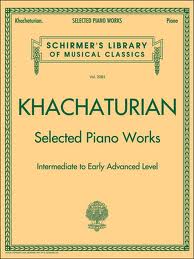
Khachaturian album

I’ll compare it to the older MCA edition pictured here, which I found in my local library:
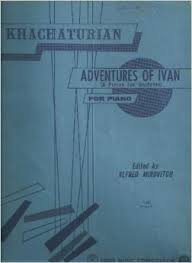
Adventures of Ivan

Please use any edition you may have on hand.  You may certainly grab a copy HERE if necessary, but try to support your local music store if you can.  NOTE:  After a Google search I found that a digital download is available on Scribd, but I encourage you to purchase a hard copy to have available for your students or just for yourself.

Remember to post your reactions for the selected pieces each week of August.   I look forward to what you have to say, whether or not you’ve taught or played the pieces before.

Along the way I’ll comment on some of the specifics I notice in both the Schirmer and MCA editions and offer some insights for teaching.

Post your comments and certainly ask questions in the Reply section below or on the FB group page HERE.  I’ll answer questions as quickly as I can.  And others may chime in on questions, too!

Enjoy learning more about this imaginative set!

 

By

Winner, Winner, Chicken Enchiladas!

And-the-winner-is___-copy

Well, at least here in San Antonio, Chicken Enchiladas are more appropriate than Chicken Dinner! 😉  Thanks to you all of you who participated in the inaugural Kabalevsky Piano Play-Along.  It was so much fun to play through Kabalevsky’s set of timeless pieces and hear all of your reactions as well.   Since this is the first prize drawing for the Play-Along, I included everyone who made some sort of comment either here or on the Facebook group page.

THE 5 WINNERS ARE:  Julie I.,  Debby Shahan, Nancy Wang, Helen Russel, and Kathy Williamson!  

Each of you will receive a complimentary copy of the Kabalevsky, 24 Children’s Pieces, Op. 39 from Hal Leonard. *Please email your complete street address to me, Elizabeth, at elizabeth@pianoteachercamp.com so we may get your copy to you soon.

A big thank-you to Hal Leonard for their generosity!  We look forward to awarding more prizes for future Play-Alongs.

Stay tuned…..the Play-Along topic for August will be announced soon!


By

Kabalevsky Piano Play-Along: What Are Your Favorites from the Op. 39?

Unknown-824-pieces-for-children-op-39-dmitri-kabalevsky-paperback-cover-artSo what are your favorite pieces from Kabalevsky’s Op. 39 24 Pieces for Children.   List them here and you’ll earn an entry to the August 1 prize drawing! Explain why you like a particular piece (or two), and earn a second entry!  What about a new fave?  Ready, set, go!

TITLES:   1. Melody  2. Polka  3. Rambling  4. Cradle Song  5. Playing  6.  A Little Joke  7.  Funny Event  8.  Song  9.  Song  10. A Little Dance  11.  Song of Autumn 12.  Scherzo  13.  Waltz   14.  A Fable  15.  Jumping  16.  A Sad Story  17.  Folk Dance  18. Galop  19. Prelude  20. Clowns  21. Improvisation  22. A Short Story  23. Slow Waltz  24.  A Happy Outing

By

Kabalevsky, Op. 39, Play-Along: Post Seven (Nos. 21 – 24 Reaction)

We’re coming down the homestretch now.  Don’t forget to post your final comments on these pieces or on any of the previous by July 31.  Would love to know which of the 24 are your favorites and/or new favs.  Those who post at least 3 times, either here or on the Facebook group page, go into the prize drawing on August 1.   Can’t wait to see who wins!

If you missed last week’s reaction post (the 6th one) on Nos. 17 thru 20, you can read it HERE.

Quick scan thoughts for Nos. 21 thru 24:

  • As a group these pieces are the most difficult in the set, with No. 24 rising to an intermediate level.
  • All are 24 mm. or longer.
  • More independence in the LH required especially as it performs a more contrapuntal role.
  • Syncopation is more prevalent.
  • A wide range of the keyboard is utilized throughout.
  • Continued complexity in opposing rhythms and articulations between the hands.

Thoughts while playing….

No. 21  – Improvisation 

Such a melancholic, misterioso piece and it does sound improvisatory with it’s wandering quality.  You could call it a modern 2-part invention of sorts and it’s a wonderful piece for teaching continuity and long line.  

2 interesting observations:

  1. On page 1 (mm. 1 thru 18) the RH plays on the “and” of beat 1 in most every measure and on page 2, the LH as well.
  2. The most intense part of the piece, at least in terms of volume and range, is in measure 11 (quite early in the piece), and yet in the following 33 measures it never reaches a dynamic higher than mp.

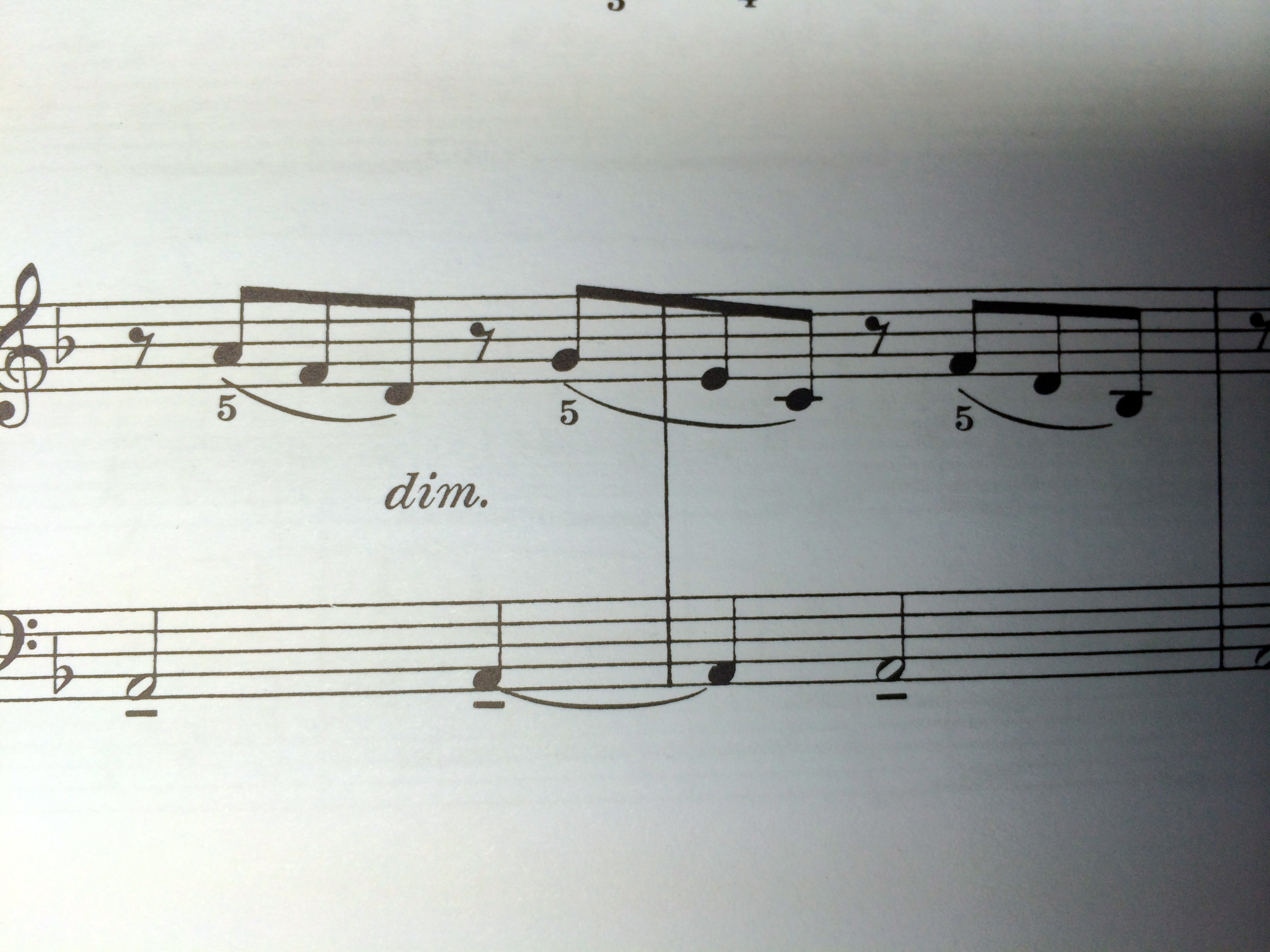
I especially enjoyed the hemiola effect Kabalevsky inserted here (mm. 15-16):

IMG_0556

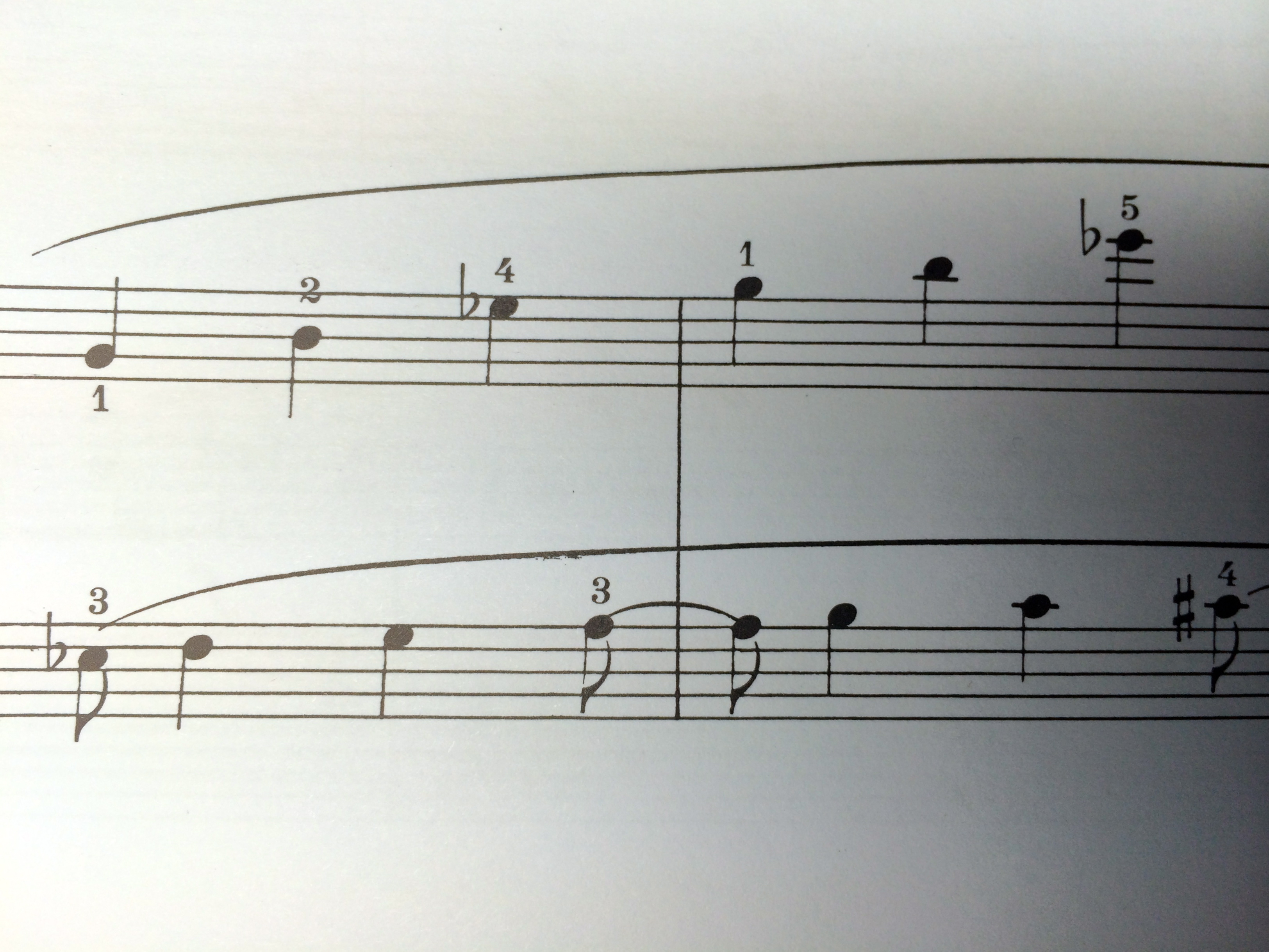
and the lovely and unexpected harmonic shift to the flat II chord here in m. 31 (E-flat major):

IMG_0555

Here’s a tender performance by Jason Sifford of the Univ. of Iowa Piano Pedagogy Project:

Read More

By

Summer Book Reads: “The Creative Habit” by Twyla Tharp

Twyla Tharp“The composer Igor Stravinsky did the same thing every morning when he entered his studio to work. He sat at the piano and played a Bach fugue… repeating the routine each day in the studio induced in him some click that got him started.”

American choreographer Twyla Tharp’s book The Creative Habit has a unique bent that is focused more on the habit of doing art as opposed to trying to explain what it is and why it’s important. The result is a book that can be very helpful to people from all walks of life who want to be more creative and develop the habits that go with it.

There is a sub-genre of self-help books on creativity. Some are good, some are fuzzy-headed, and some are tedious expositions written by observers of creative people.  Eventually though, understanding creativity comes down to understanding the process of it all. How any artist can go about making something from nothing, is really not mysterious, but usually is the result of a lot of hard work.

Tharp’s book does not shy away from this “perspiration over inspiration” notion. These ideas seem best explained by people who do art and have done it for a life time. In this regard, Tharp’s book speaks with authority, practicality, and real-world experience.  Anecdotes and creative exercises are drawn from her own work and the work of other creators. Chapters like “Rituals of Preparation”, “Your Creative DNA”, “Scratching”, and “Spine” go a long way in helping the reader think about how they can apply the principles she outlines and enjoy the process of being creative.

Twyla Tharp has had a 35+ year career as one of America’s greatest choreographers.  Her works have been performed by the Joffrey Ballet, New York City Ballet, American Ballet Theater, Paris Opera Ballet and more. Her work work for the Broadway musical Movin’ Out earned her a Tony award. She is an honorary member of the American Academy of Arts and Letters.

Highly recommended. $16.00. Published by Simon & Schuster Paperbacks.   Available at Amazon for $9.04.  Read sample pages HERE.


By

Kabalevsky, Op. 39, Play-Along: Post Six (Nos. 17 – 20 Reaction)

Please don’t stress if you’re a little behind on the Play Along (like this post) or if you’ve just discovered the Play Along.  You can start now with the first Reaction post here and catch up a little each day.  You have plenty of time to read through the pieces and post comments until July 31.  The prize drawing for those who have read and posted at least 3 comments (either here or on the Facebook group page) will be held on August 1.

If you missed last week’s reaction post (the 5th one) on Nos. 13 thru 16, you can read it HERE.

Quick-scan thoughts for Nos. 17 thru 20:

  • The pieces are now solidly at the early intermediate level and the hands are really moving about.  LH is more technically demanding than seen before.
  • More pieces with 16th notes, and there are a multitude of rhythmic patterns present.
  • More complexity in the HT playing with opposing rhythms and articulations.
  • Kabalevsky seems to favor 2/4 time at this stage and earlier as well. It promotes a more lively character in the faster pieces.
  • In these four selections, the hands are approx. one octave apart most of the time.

Thoughts while playing….

No. 17  – Folk Dance  (I see “Dance” indicated in a different edition) 

When presented with the option of this piece, or No. 18, 19, or 20, one of my summer students selected this one in an instant.  She said she liked how the hands matched each other (we’ve seen Kabalevsky’s parallel movement of the hands in several pieces before).

My student is at the intermediate level and she learned this piece hands together in one week! (medium tempo) but….I must admit that she was highly motivated.  She said she really enjoyed how the hands jumped around and imitated each other, first the RH in m. 5  and then the LH in m. 21.  This student was familiar with D major (the scale, chords, and basic cadences) so the keysignature wasn’t a major stumbling block.

She and I worked on using forearm staccato similar to what is demonstrated here:

Read More

By

2-Minute History: 1. The Music Staff

Script Staff

Every piano teacher occasionally encounters a curious student who just has to know more about a particular music history topic or term, or some facet of the piano.   Often we’re caught off-guard and don’t have a formulated answer ready for questions like:  “Who invented the staff?” or “Why are there 3 pedals?” This 2-minute History post about the music staff is the first of a series of posts dedicated to helping you sort out the gnarly details in order to provide a knowledgeable, yet brief explanation. Today’s post is provided by James Syler, composer, who teaches at The University of Texas at San Antonio.

Today’s 5-line staff has become universal for notating music, but arriving at this point was a long journey.   Read More

By

Kabalevsky, Op. 39, Play-Along: Post Five (Nos. 13 – 16 Reaction)

Ok.  A day late, but I just couldn’t resist an extra day of 4th of July vacay when the opportunity presented itself.  Hope your summer is going well.  Are you managing to play along?

If you missed last week’s reaction post (the 3rd one) on Nos. 9 thru 12, you can read it HERE.

Quick scan thoughts for Nos. 13 thru 16:

  • We’ve ventured into more pieces in triple time.
  • The melodies have become more expansive (larger intervals contained within)
  • Kabalevsky has continued his inclination towards parallel movement between the hands (nos. 14 and 15)
  • A keysignature of more than 2 sharps or flats has appeared (no. 14)
  • A piece in the Dorian mode has now appeared (no. 16)

Thoughts while playing….

No. 13  – Waltz  (I see “Dance” indicated in a different edition) 

I gave this to a student this summer as a special project and I must say that she is “in love” with this piece.  She just can’t say enough good things about it such as:

“I like the beginning” – (at the first lesson)

“I just love the RH” – (at the second lesson)

I think this broad and evocative RH melody offers instant appeal, especially when combined with the sad key of D minor.  I’ve had several students in the past decide to learn this piece upon hearing it just once.  And if you want to teach both distinctive phrase shaping and the waltz style, then this is a great go-to.

When first introducing this, my summer student didn’t notice that the LH was in the treble clef (that’s one thing I like about Kabalevsky; he mixes those clefs).  We navigated the LH at the first lesson by playing only the lowest note of each stacked interval.  We named each low note as she played continuously from measure to measure (EX:  “D – D- rest, D – D – rest, etc.”).  Once done, she better understood how the LH moved along .  Later she played the LH as written watching the lower notes move horizontally while detecting the harmonic interval above (3rd vs. 4th vs. 5th).

Here she demonstrates the detached LH with a forward wrist motion for lightness:

Here, with her RH, she is showing the arching of the hand as it rocks from one side the other while playing the broken intervals (mm. 16 to the end).

She mentioned afterwards that she forgot the diminuendo in this excerpt above. Good catch.

.

No. 14  – A Fable (seen before as “A Gay Little Story” in a much older edition.)

Similar to No. 20 in this set,  “Clowns,”  students love the major-minor shifts in this piece.  They discover that the dynamics follow the harmonies and then they spot the form of the piece instantly.  The student in the video below told me what convinced him to learn this piece:

“I liked all the movement, all the techniques involved, and the patterns.  It’s jumpy and happy, and I liked the A Major sound and how it felt under my fingers once I learned it, especially with the staccatos.”

It’s a wonderful piece for developing touches.  Later I asked him what was most difficult about learning this piece, he said:

“Getting the legato vs. staccato in mm. 3-4, combined with the drop-lifts of the wrist.”

After mastering this piece at a faster tempo, his tendency was to rush with all the fun he was having.  It’s quite the finger tickler at that point.  Here’s his medium-paced version:


No. 15 – Jumping  (I’ve seen this titled as “Galloping” and also “Leap Frog”)

Indeed this is jumpy.  It looks daunting to some students at first because of the  eighth rest- eighth note rhythmic idea (see RH, measure 1).  They forget that the eighth rest plus eighth note combination is the equivalent to 2 beamed eighth notes (of which I remind them).  I start out by saying that the LH in measure one is the hand that’s “jumping” (2-note slur followed by a staccato quarter note; I demo this) and then I tell them that the RH is “skipping” in m. 1 (due to its delayed start on the “and” of beat 1, which I also demo).

I have students learn the entire piece with both hands playing the straightforward rhythm of the 3 quarter notes per bar.   RH plays exactly with the LH in measure one, and then in measure 9, the LH would copy the RH, and so forth all the way to the end.  They can also match the wrist lifts by playing this way:

Here’s a demo:

After learning the piece with the LH and RH playing simultaneously on quarter notes and mastering the notes and fingering this way, it’s so easy for students to delay one hand by playing on the “and” of beat one.  I have my students count “1 – and, 1, 1” for each measure of the piece as they coordinate the rhythms of both hands.  Tapping the two rhythms together on the keyboard can also solidify the coordination.

They love the gymnastic effect of this piece once they get the hang of it.


No. 16 – A Sad Story  (also seen as “A Sad Tale” )

This is the follow-up to the happier story in No. 14, “A Fable.”  I think the two pieces would make a nice pairing.  The student could play No. 16 first and follow with No. 14.  Better yet, add No. 22 “Short Story” to the set and make it a trio!

I hear this piece in the key of “A” Dorian.  It seems to center itself on “A” as “home” and keeps returning to “A” even though it finally settles on “E” at the end.  It’s funny how the final “E” didn’t sound so incomplete to me.  My ear could accept it as a final note.

Now the question is:  which hand is really the melody?  The LH in the opening is marked cantabile with a louder dynamic which leads you to believe LH might be the melody though it’s not very lyrical. The RH has a nice sway to it which sounds cantabile as well.  Perhaps it’s truly 2-voice writing and both hands create compatible melodies.

Here’s Jason Sifford’s performance with the Univ. of Iowa Piano Pedagogy Recording Project. .  I like how he maintains an Andante tempo with just enough movement for a cantabile feel.

Look forward to your thoughts on this varied set for this week.  Have you taught any of these before? Any tips to share?

Play-Along Schedule:

  1. Introduction Post:  June 1
  2. Kabalevsky, Op. 39, Nos. 1 thru 4 reaction:  June 2
  3. Nos. 5 thru 8 reaction:  June 9
  4. Nos. 9 thru 12 reaction:  June 30
  5. Nos. 13 thru 16 reaction:  July 7
  6. Nos. 17 thru 20 reaction:  July 14
  7. Nos. 21 thru 24 reaction:  July 21


By

A Note About Kabalevsky Editions

images-4

When deciding on which Kabalevsky edition to use for the Piano Play Along, I did a little research to try and find the one that Kabalevsky himself may have overseen and edited, i.e., an “authoritative” edition.  I consulted with Joshua Parman, Classical Music Editor at Hal Leonard Corporation.  Here’s what he had to say:

“Because USSR copyrights were not recognized by many other countries for much of the last century, unauthorized editions of Kabalevsky’s music appeared until the mid-1980s all over the world. In addition, the rights of many individuals to have legal access to and representation for their own intellectual property was quite different in communist Russian than it is now under a different government structure. As a result, some composers simply did not make the effort to oversee “authorized” editions. Most illegal and inaccurate Kabalevsky editions have been suppressed under new international legislation in the last thirty years. However, the historical facts make the question of “authoritative” editions of Kabalevsky’s music thorny at best, and at worse, impossible to know. Supposedly, the Schirmer edition was seen and approved by Kabalevksy in 1985, but there is no evidence immediately available to support this claim. In editing the new Schirmer edition of opus 27, I found only one note difference between the Boosey and Schirmer editions and only a handful of differences in articulation and dynamic markings. Though this is a different opus number, it is telling that the editions were virtually the same.
 
So the answer is, we don’t know which is “authoritative.” But based on the things we do know, I would say Schirmer is the best bet.”

I found this very helpful.  I’ll probably continue to give my students the Schirmer or Boosey editions of Kabalevsky or at least consult them for accuracy if the student is using a mixed anthology.


By

Kabalevsky, Op. 39, Play-Along: Post Four (Nos. 9 – 12 Reaction)

PLEASE forgive the delay and the technical glitch in getting this THIRD reaction post up for you.  Nothing like technology keeping your site so secure that it prevents the owner from logging in. Sigh.  Thanks for hanging in there. We should be on a roll now.  I have lots of interesting posts to share with you in the coming days!

It’s still not too late to start the KABALEVSKY PLAY ALONG. Tell your friends.  You can jump in whenever you like and post a thought or two here in the Replies below or on the Facebook “Piano Play Along” group page.  I’d love to hear from you especially if you’ve had experience in teaching any of the pieces below or if you’ve discovered a selection you really like.  Don’t hesitate to post a question.  I’ll answer as quickly as I can.

Did you miss my second reaction post? You can read it HERE.

Quick scan thoughts:

There’s quite a contrast in style within this set of four pieces (Nos. 9 – 12) with a jump in difficulty in No. 10 with its dotted rhythms, movement around the keyboard, cadences, and a heavy use of accidentals.  Kabelevsky is still promoting various keyboard touches with staccatos, slurs, and accents.  He seems to enjoy placing the hands an octave apart, two octaves apart, and as little as a second (step) apart.

Thoughts while playing….

No. 9  – A Little Dance  (I see “Dance” indicated in a different edition) 

If taken too slow, this could sound more like a march than a dance.  If played at the Allegro molto tempo, it sounds more like an effective romp or stomping dance with a feeling of 1 beat per bar.  A student should already be comfortable playing strong clear triads in the LH in order to manage the 4-note chords.  I told a student to think of G minor with an F in m. 5 and then shift to G major against the F.  This seemed to help him know exactly what to look for when targeting these crunchy LH chords.

In the last 4 measures, the LH expands and contracts quite rapidly.  I asked the student in the video below to shift to the new LH positions during the rests so he could manage the chord changes more easily.  Here’s a short video showing this:

This piece is quite effective if the dynamics are played in sharp contrast to each other.  Ask the student what might be happening in the actual dance during the echo sections.  Your thoughts on what it could be?

No. 10  – March  (I see “Quick March” indicated in a different edition) 

This is quite a jump in level compared to the pieces before.  I would teach this later down the line after a student has had solid practice with dotted quarter – eighth note rhythms and a little experience with sixteenth notes.  The student in the video below has had some previous training in 16ths, but not much.  He’s also played a few pieces with 2 sharps or 2 flats in the keysignature.

Here are his thoughts on the challenges he found in this piece (in his words):

“It’s a bit tricky.  You have to be exact with your rhythm.  I can picture a march with this and it sounds like a trumpet playing.  The hardest part was mm. 8 through 12 because of the flats and because the LH jumps in with the melody in mm.  9-10.  The last cadence is also tricky because it moves downward instead of upward like in mm. 3-4.”

In the video below, I asked him to play the dotted 16ths incorrectly vs. correctly.  The first time he plays, the 16ths sound more like triplets and in the second playing he makes the rhythms sound more like true dotted eighths followed by sixteenths (though it’s still a little bumpy; he’s still working on creating a better demo).  Sluggish 16ths are a common problem for students when playing dotted-eighth sixteenth rhythms.  It takes careful listening, and the jumpiness here doesn’t help matters.

No. 11 – Song of Autumn  (I see “Autumn Song” indicated in a different edition) 

This piece reminds me very much of No. 8 “Song” with its parallel melodies, except for the fact that Kabalevsky begins this piece on the anacrusis (pick-up) rather than on beat one.  It gives the piece a sense of lilt despite the somber B minor key.  I might tell a student to imagine the wind blowing leaves in different directions as their hands move upward then downward in tandem through the slurs.  The hands playing 2 octaves apart seems to add a sense of heaviness or a grey, cloudy aura to an autumn day.  Have the student describe what he/she sees on a B minor autumn day.

Here’s a student demo.

The student wanted to achieve a steady Andante feeling.  His brother, standing next to him while taping this, told him he needed to add more shape to his phrases and more dim. where indicated. 😉

No. 12 – Scherzo  

This piece is similar to the No. 6 – “A Little Joke” with the use of a repeated pattern moving stepwise up and down the keyboard.  You could secure the rhythm of the main melodic motive using words like “blue-berry muf-fin” (that’s the first thing that came to my mind – always thinking of sweets!).  The student wouldn’t need have experience with 16ths to play this piece well, but I would at least explain the difference between 16ths and 8ths if the student didn’t already know.

There could be a tendency to rush with this piece once it starts moving along.  Once again, the brother of the performer in this video piped in and told him that he rushed a little at the end.  This was a younger brother informing the elder.  Picky picky…

Look forward to your comments!

REVISED Play-Along Schedule:

  1. Introduction Post:  June 1
  2. Kabalevsky, Op. 39, Nos. 1 thru 4 reaction:  June 2
  3. Nos. 5 thru 8 reaction:  June 9
  4. Nos. 9 thru 12 reaction:  June 30
  5. Nos. 13 thru 16 reaction:  July 7
  6. Nos. 17 thru 20 reaction:  July 14
  7. Nos. 21 thru 24 reaction:  July 21


Related Posts Plugin for WordPress, Blogger...